


Key Takeaways:
|
Millions of devotees and visitors come to visit one of South Asia’s most intense and visually powerful religious festivals, Thaipusam!
This three-day festival is celebrated by gathering for large processions, lifting heavy Kavadis and milk-filled pots, getting skin pierced, and an extreme sense of devotion, drawing massive crowds to Kuala Lumpur.
This guide is designed specifically for tourists visiting Malaysia during Thaipusam. It explains what the festival is, when and where it takes place, the key rituals you’ll see, and most importantly, how to plan your visit.
From transport options and parking to crowd navigation, this blog covers everything you need to experience Thaipusam respectfully and safely!
What is the Thaipusam Festival?
A Tamil Hindu festival that is dedicated to Lord Murugan, the god of war and courage and also the son of Shiva and Parvathi.
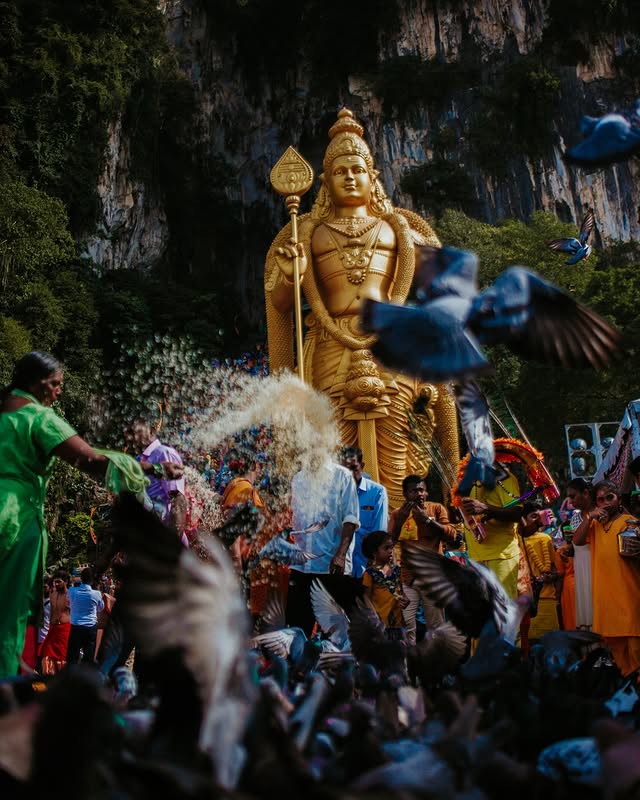
It is observed on the full moon day of the Tamil month of Thai, which usually falls in January or February. The name “Thaipusam” itself comes from the combination of Thai (mid-January & mid-February) and Pusam (the brightest star during the full moon).
The festival celebrates Lord Murugan’s victory over evil, emphasizing devotion, sacrifice, and gratitude.
The Mythological Significance of Thaipusam
Mythologically, there are two legends behind the celebration of Thaipusam.
This was the day when Murugan’s mother, Shakti (Parvathi), gave him a powerful ‘Vel’ (spear).
Murugan used that very spear to attack and retaliate against an asura called ‘Surapadman’ after he attacked ‘Devlokha’ (World of Gods).
Secondly, the legend says that when a Lord Murugan devotee, named ‘Idumban’, was tasked with carrying two hills from the Himalayas to Southern India, he could no longer lift the hills while crossing Palani (a sacred hill in Tamil Nadu, India).
That was because of Murugan, disguised as a boy, blocking Iduman’s path. After a battle, Idumban died but was later brought back to life by Murugan.
Once Idumban was back alive, he prayed to God and requested two wishes:
One of Murugan’s devotees, known as ‘Idumban’, prayed and wished for two things:
- Anyone visiting Palani (Sacred Murugan temple) with deep devotion and carrying a ‘Kavadi’ must be blessed.
- Idumban, himself, wanted to guard the temple
And yes, Lord Murugan granted his wish, and that is why millions of people carry Kavadis.
Where and When is Thaipusam Celebrated
Thaipusam falls on slightly different dates each year, as it follows the Tamil calendar.
Not just in Malaysia but worldwide, Thaipusam this year will be celebrated on
February 1st, 2026.
But since it is a multi-day festival, the upcoming festival is expected to be from
January 30th to February 1st.
The Thaipusam festival in Malaysia will be taking place at the famous Batu Caves in Kuala Lumpur. The main shrine at this cave is known as the ‘Sri Subramaniar Swamy Temple’.
Expect crowds to start gathering at the Baku caves 1-2 days before the main event.
February’s full moon falls on a Sunday this year, but usually, Thaipusam is a public holiday in Malaysia.
Why Thaipusam is Celebrated in Malaysia
A major part of Malaysian citizens are ethnically Indian; particularly, they are Tamil Hindus.
A Tamil leader built the Hindu temple at Batu Caves in the 1890s, dedicating it to Lord Murugan. Over time, it grew popular, and now it is the biggest Hindu temple outside India!
Today, millions of devotees and tourists visit this place every year to celebrate Thaipusam and seek the blessings of God.
What Are the Rituals at Thaipusam?
The rituals start 2 days before the main event of Thaipusam.
- January 29th: A yellow flag with a picture of a rooster will be hoisted outside Batu Caves. The rooster symbolises Murugan’s army during the war.
- January 30th: A humongous 21-foot silver chariot carrying Lord Murugan will start its procession from the Sri Mariamman Temple in Kuala Lumpur. Devotees pull it through the streets towards the Batu Caves for an approximately 15-20 km journey.
- January 31st: The chariot arrives at Batu Caves.
- February 1st: The main Thaipusam event.
Main Day of Thaipusam
The rituals and ceremonies will happen throughout the day, starting from early in the morning to late at night.
Below, you can find the step-by-step process followed by the devotees at Batu Caves.
Sacred Bath (Abhishekam)
Before sunrise, priests at the Batu Cave temple will bathe the deities using rosewater, milk, honey, and ghee. Later finishes it off by applying sandalwood paste, sacred ash (vibothi), and kumkum.
Fasting
People will start their fasting roughly 48 days before the main event by eating only one vegetarian meal a day. This fasting also continues on the day of the event.
Carrying Kavadi & Paal Kudam
Devotees carry a kavadi or a paal kudam on top of their heads and shoulders. Kavadis symbolises the burdens and sacrifices. Whereas Paal Kudam represents devotion and gratitude.
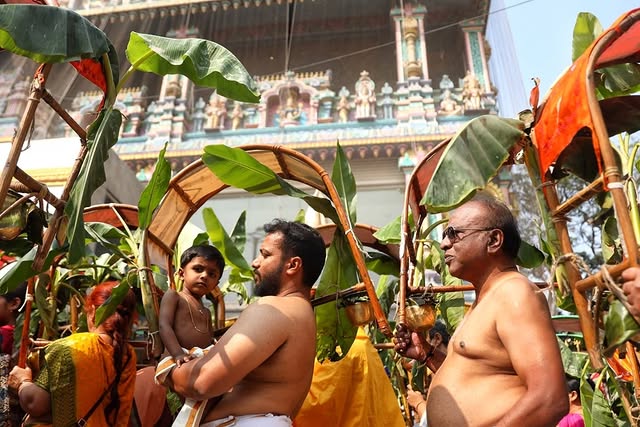
Note: Paal Kudam and Kavadi: Sanctified pot of milk or a large wood/metal structure that devotees carry on their shoulders and join processions.
Piercing
This is the most intimidating part of this whole festival. People with extreme devotion will temporarily pierce multiple parts of the body. Including tongue, cheeks, ears, forehead, back, chest, hands, and shoulders. Turmeric paste will be applied to stop minor bleeding while piercing.
The piercing ritual represents the ultimate surrender and conquering of ego/pain, just like Lord Murugan’s spear piercing the demon.
Cleansing
At the Batu Caves base, devotees wash feet/hands in flower-infused water and sprinkle theertham (holy water) on them. It symbolizes shedding sins.
Climbing
From the base of the Batu Caves, worshippers will climb the colourful 272 steps towards the Sri Subramaniar Swamy Temple inside the cave. Climbing will take about 1-2 hours as the crowd moves slowly.
Entering the Temple
As the people enter the temple, they witness the deity (known as Dharisanam/Dharsan).
Later, they hand over the paal kudams (milk pots) to the priests who will bathe the deity with the provided milk.
After prayers are completed:
- Piercings are carefully removed
- Devotees break their fast
- Sacred food (prasadam), often Panchamrutham, is distributed
Finally, the devotees break their fast by consuming a holy sweet dish (prasadam), known as “Panchamrudham”.
Smaller Observations
Apart from the main rituals, there will also be things happening on the festival grounds like,
- Music: The festival will have a lot of artists playing various instruments and singing religious songs.
- Alangara Kavadi Aatam: Kavadis decorated with peacock feathers will be carried and danced to the music.
- Kavadi Assistance: Family members or friends accompany devotees to provide support.
- Free food: Known as Annadhanam, volunteers outside the temple will give out free vegetarian food.
How to Get to Baku Caves?
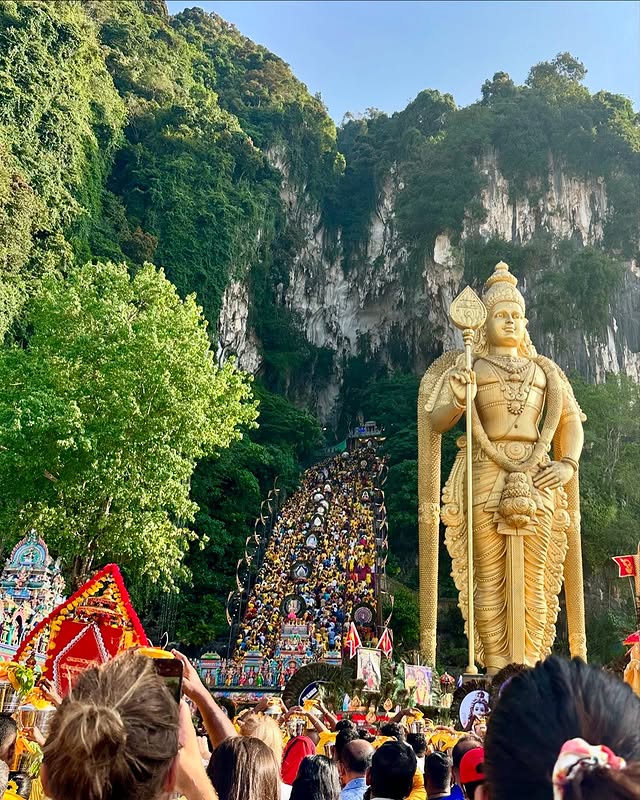
There are four ways to get to the Batu Caves from anywhere in Kuala Lumpur.
Train
The KTM train is Malaysia’s version of ‘metro’. From your desired starting point, you can get off at the Batu Caves KTM Komuter Station. This station is on the purple colour line.
In 2025, KTM announced a 25-hour ‘free’ train service during Thailpusam. This year might follow the same!
Taxi
People can use private taxis or an app like ‘Grab’ for convenience.
Bus
173 and 172 Rapid KL buses gather people from central KL to Batu Caves. (You can use Google Maps to find out the bus details!)
Private Transport
This option is generally not recommended during Thaipusam due to the massive crowd. It will be tough to navigate through the heavy jam, and multiple roads around Batu will be closed for crowd control.
However, if you are willing to go on your own, there are two options:
- Park your vehicle 2-3 stations before the KTM Batu Caves Station and catch a train to Batu Caves. You can park near Taman Wahyu Station or Kampung Batu Station. It will take roughly 7-15 mins from these stations to Batu Station by train.
- A lot of people prefer to park their vehicles at Arulmigu Sri Muneeswarar Aalyam behind Batu Caves (1.3 km walk). For a small fee, you can have access to a big parking space. However, it fills up quickly during Thaipusam, so plan accordingly.
Note: Many devotees and visitors park illegally outside Batu Caves and on the flyover outside the caves. However, this can be done at your own risk.
Tips and Extra Information for the Tourist/Visitors
- Attending Thaipusam at Batu Caves is free; there are no entry or participation fees.
- You don’t have to participate in the festival (lifting Kavadis or piercing) to visit the main Murugan temple in the cave.
- The entire Batu Cave will be heavily crowded. Millions of people in one place are an easy target for pickpockets.
- The temperature in Kuala Lumpur on February 1st can be anywhere between 30°C and 33°C. Carry a water bottle and a cap.
- Dress modestly, as it is a religious site. It will be appreciated if you wear something yellow/orange (all devotees will wear this colour, because these are the colors of Lord Murugan). However, it is better to cover your shoulders and knees to respect the culture and religion.
- Don’t wear black clothes or anything that is dark, like navy blue. These colours are considered inauspicious.
- There will be shops at the foothills selling snacks, refreshments, souvenirs, jewellery, religious items like garlands, prayer beads (mala), sacred ash (viboti), and more!
- The festival will be extremely loud and overwhelming with drumming and songs from loudspeakers. If you are a person who is sensitive to sound, it’s best to carry earplugs.
- Pictures are allowed to be taken at the festival, but take permission before clicking pictures of devotees. (Usually, everyone’s happy to be clicked!)
- If you want to climb the colourful steps of Batu Caves, start climbing before 7 AM or after sunset to avoid getting stuck between crowds.
Conclusion
The Thaipusam festival in Malaysia is where people carry a deep emotion of devotion in their hearts and minds. It is so intense that even piercing skin becomes bearable in front of their faith.
The festival is definitely not for the faint-hearted. And yes, the rituals will leave you wondering why, but it is important to visit the festival with an open mind and respect the culture.
However long you stay, one hour or the whole day, it will surely leave a lasting impression.
FAQs on Thaipusam Festival in Malaysia
1. Is Thaipusam a holiday in Malaysia?
Yes, Thaipusam is a public holiday in Malaysia. This festival falls on different dates every year, and in 2026, it falls on 1st February, which is a holiday.
2. Why is the Thaipusam festival celebrated in Malaysia?
According to Hindu mythology, Thaipusam is celebrated because Lord Murugan won the battles against an asura (demon) called Surapadman. And Malaysia has a lot of Tamil Hindu people as permanent residents/citizens.
3. What is the dress code for Thaipusam?
Men carrying ‘Kavadi’ must wear a dhoti and can cover their chest with just malas. Meanwhile, women carrying ‘Pal Kudam’ need to wear a saree. All clothing must be in orange/yellow colours. Visitors can wear anything, as long as it is modest and the colour yellow is appreciated.
