

Key Takeaways:
- Laos is a peaceful, budget-friendly Southeast Asian destination known for mountains, waterfalls, rivers, caves, and slow travel experiences
- Luang Prabang, Pakse, Vang Vieng, Vientiane, and Nong Khiaw offer unique travel styles, from cultural heritage to adventure and scenic escapes
- Must-do experiences include waterfall hopping, river cruises, tubing, hiking viewpoints, cave exploration, island hopping, and ethical elephant encounters
- Laos is affordable for Indian travelers, with low daily expenses, though international flights can be costly
- Choosing the right base town helps travelers match their itinerary to their interests, whether culture, nature, adventure, or relaxation
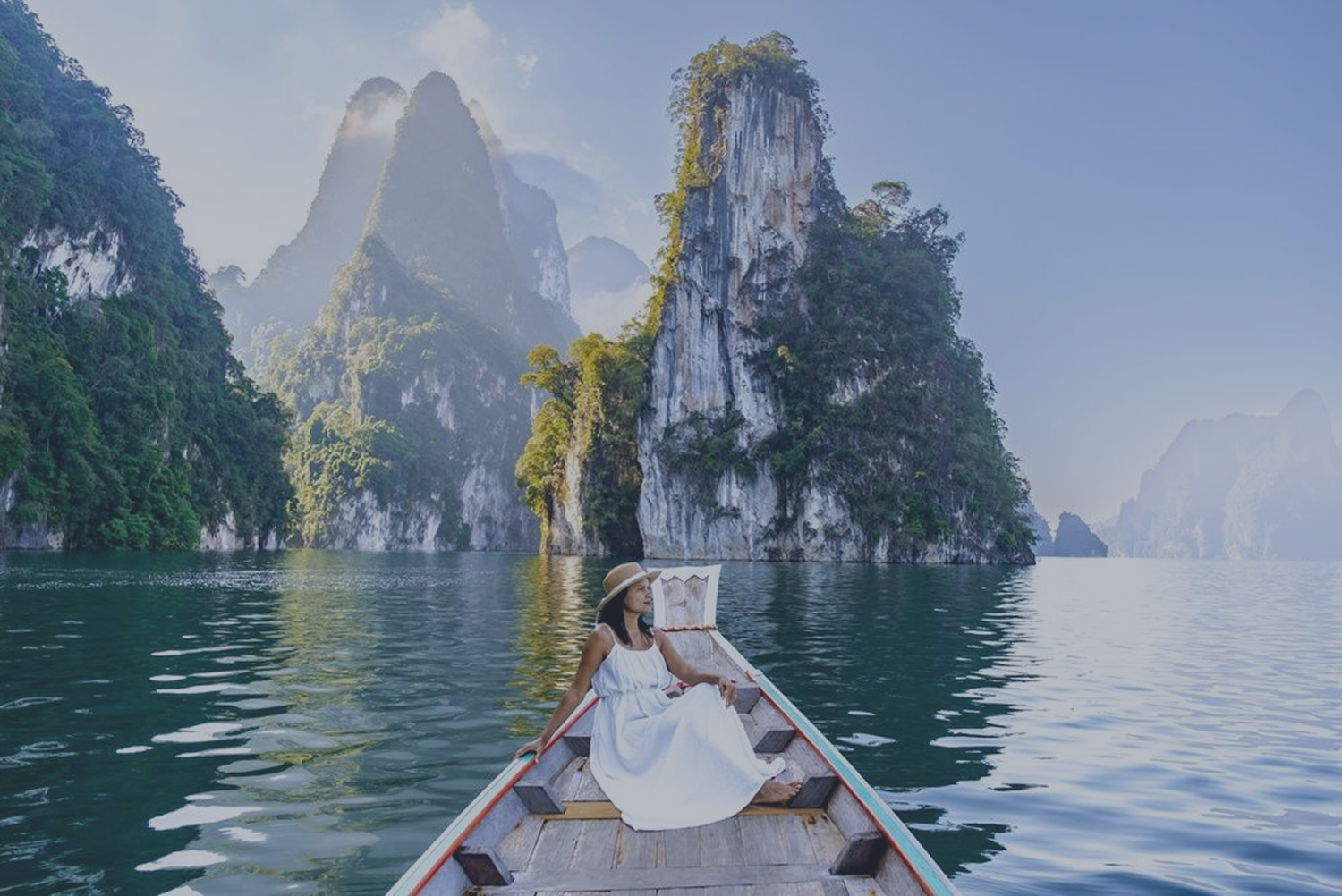
Laos is a landlocked, hilly country packed quietly between some of Southeast Asia’s biggest tourism giants: Thailand, Vietnam, China, Myanmar and Cambodia. Yet it doesn’t feel like the rest. Laos moves at its own slow pace. Mountains, misty valleys, calm rivers, and tiny villages fill up most of the country, giving it a rugged yet authentic vibe.
In this blog, you’ll get a clear idea of the places to visit and things to do in Laos. Experience famous cities like Luang Prabang and Vientiane, as well as smaller gems like Nong Khiaw and Vang Vieng.
Under each location, you’ll also find specific activities curated so you know exactly what to expect. By the end of this guide, you’ll know exactly which towns suit your travel style and what adventures you can look forward to in each of them.
15 Best Things You Can Do In Laos
I’ve highlighted four main towns and cities in Laos: Luang Prabang, Pakse, Vientiane and Vang Vieng. Under each of them, you’ll also find nearby attractions along with the distance from the main town. This makes it easy for you to understand how far each place is and which town you should stay in to visit a particular attraction.
The last town mentioned in this blog is a bonus attraction. A hidden gem in Laos offering multiple activities while having the most amazing views!
Luang Prabang Town
A UNESCO World Heritage city that is much loved by its visitors is Luang Prabang. It has both Laotian and French architecture, as it was one of the Indochina countries under French rule from 1893 to 1953.
Here, you can roam around the small alleys, looking at the pretty French buildings, flower shops and little cafes, and watch the colorful butterflies in the city. Now, the city is pretty commercialized, but for all its good reasons.
Ideal for individuals who want to work from a town with convenient amenities. And also a great getaway to the country of Laos for new travellers.
Things to do in Luang Prabang: waterfalls, Mekong River excursion, and city sightseeing.
Waterfalls
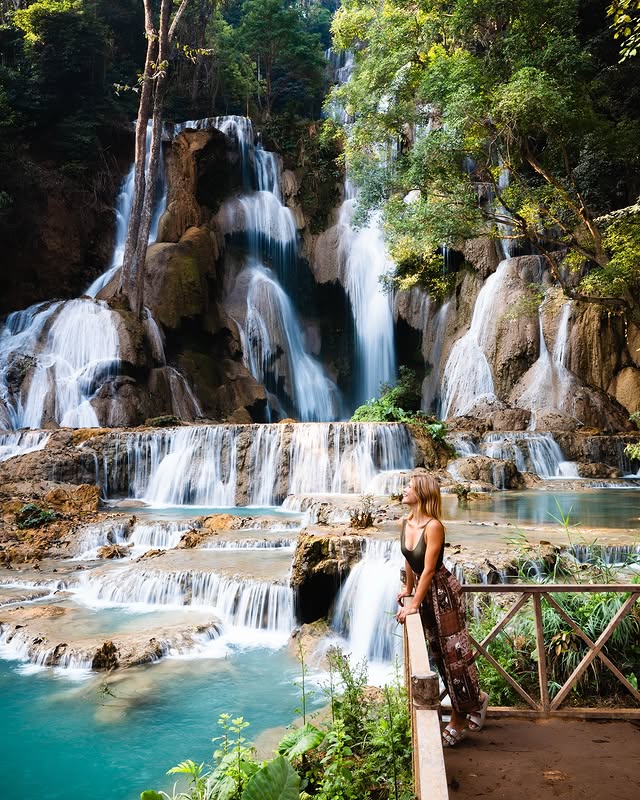
- Kuang Si Falls – The popular multi-tiered waterfalls where you can take a plunge and also have fun watching the playful bears at a conservation nearby. (This is explained in detail in the blog below.)
- Tad Sae Falls – A fall that is definitely outside the beaten path of the majority of the tourists. Located about 18 km from Luang Prabang, the only way to get to the paradise is by boat.
Mekong River Cruise
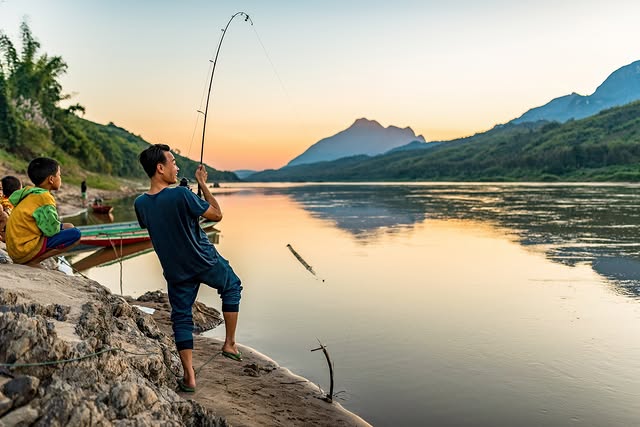
Multiple cruises depart from Luang Prabang to visit Laos tourist places like the Pak Ou Caves, Whisky Village, Hmong Village and Kuang Si Falls. Multiple companies organise this excursion.
Roaming the City
Apart from the French aesthetics of Luang Prabang, the city has other attractions as well. Visit Laos tourist spots like the Royal Palace, National Museum, Mount Phousi and the Bamboo Bridge.

Phousi Hill (Located Within Luang Prabang City Limits)
If you want to get a panoramic view of Luang Prabang, Phousi Hill is the place to be! Located in the heart of the town, standing at a height of 100 m, it gives you the best views of the town and its surroundings.
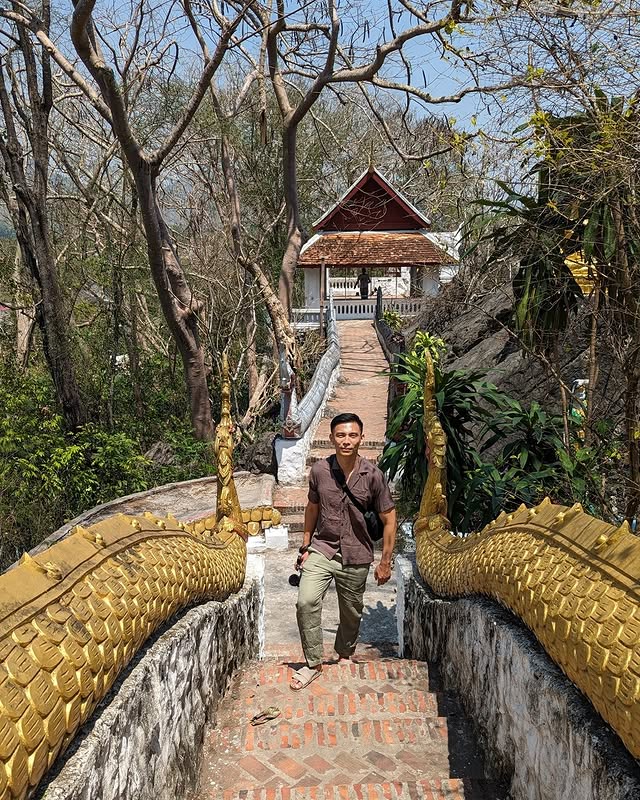
This tiny hill has multiple tiny Buddhist temples along the way and at the top. You’ll be able to see a large variety of golden Buddha statues. If you are an observer, you might spot a board on the hill with both the Laos and Indian flags on it. It states that a part of the sacred Bodhi Tree was gifted to Laos by India, under which Buddha attained enlightenment.
If you plan to climb the hill, it will take about 30-45 minutes, and you’ll have to climb approximately 355 steps.
Sunset is the best time and worst time to visit the hill; let me explain. Sunsets from the hill look absolutely stunning, but the place will also get pretty crowded during that time. If you are thinking of an alternative, sunrise might be a good option.
There are two entrances to the hill: one starts in front of the Royal Palace Museum, and the other starts near the Nam Khan River.
The 1st one is the main entrance; it’s shorter but crowded. The other one is longer but offers more views, and you’ll pass by more temples.
Note: Phousi is a sacred hill with temples at the top, so dress modestly and avoid bringing alcohol.
- Price: (Approx.)30,000 kip (122 INR) / person
- Timings: 6:30 am – 5:00 pm (These are the official timings, but the hill usually stays open for a little while after sunset.)
Wat Xiengthong (Located Within Luang Prabang City Limits)
A popular temple situated at the confluence of the Mekong River and the Nam Khan River. Built in the 1500s by King Setthatirath, it’s one of the most beautiful temples in Laos.
The walls and pillars of the temples are decorated with detailed carvings, mainly in the colours of gold, red and brown. The inside of the temple, featuring a high roof, also has these colours, along with black and navy blue. You can also spot green and blue occasionally. These walls have carvings that narrate a story.
Wat Xiengthong is a must-visit, especially during the Boun Lai Heua Fai Festival. It is celebrated during the full moon of the 11th lunar month, which typically falls in October. During this time, the temple grounds will be illuminated and flicker with 100s of lanterns and candles.
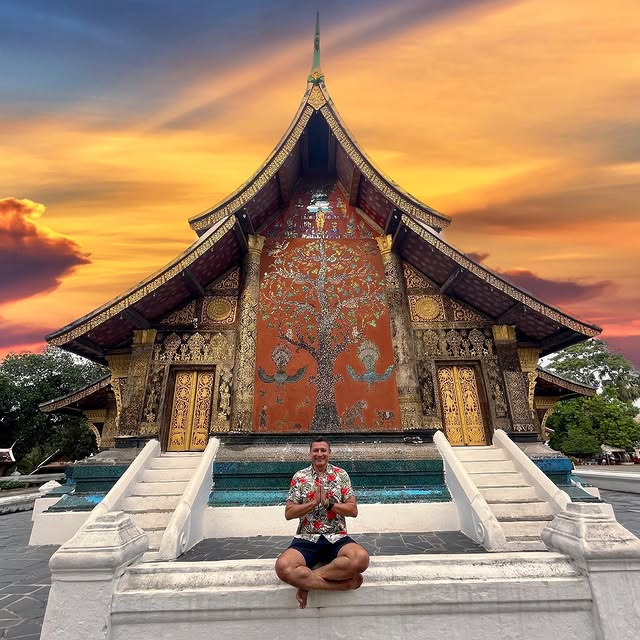
Can’t forget the main highlight of the temple, which is the ‘Tree of Life’. A glass mosaic outside the temple describes how life is connected to nature. An old tale says that two hermits built this temple next to a flame tree, and hence, a tree of life art was created in the temple.
Dress modestly and take off your shoes and hats. Also, avoid bothering the monks and women are not allowed to touch them. If you are wearing shorts or a short dress, a skirt can be rented for 10,000 kip (40 INR) outside the temple.
- Price (Approx.): 30,000 Kip (122 INR)
- Timings: 6 am – 6 pm
Ban Xang Hai Village (21 KM Away From Luang Prabang)
A riverside village, located on the banks of the Mekong River, approximately 22 km from Luang Prabang, is known for its whisky and wine. In fact, it’s nicknamed ‘The Whisky Village’. The people of this village have been making whisky for generations, and it’s known as the ‘Lao-Lao’.
Here, whisky is made from two types of rice: black and white.
The process is fairly simple. Rice is cooked until it becomes sticky. Then, it is stored in a wooden drum, and it’s left to ferment. A week later, they distill the alcohol from it (both whisky and wine).
Since this whisky is made from rice, it has a slightly sweet taste, and the bamboo bin adds an earthy flavour. However, the strength of the alcohol is no joke. Some of their liquor can reach up to 60-70% ABV! But mostly, 40-50% ABV liquor is sold to tourists.
Now, ready to hear the most bizarre thing? Some of the strong alcohols are soaked with snakes! Yes, you read that right. When you are at Ban Xang Hai village, you can see vendors selling bottles of liquor that have gigantic snakes, scorpions, and even lizards.
The process behind it is that the villagers hunt these reptiles, kill them, clean them, and place them inside the bottles before filling them up with liquor. Strong liquors will act as a natural preservative and stop the dead animal from decaying.
In some Asian countries, reptiles like snakes and scorpions are believed to have medicinal properties. People infused alcohol with the reptiles, thinking it could help with skin problems, fatigue, sexual stamina and improving overall energy in general.
These are mostly bought as souvenirs rather than for drinking, which is not too often. And the Lao-Lao Whisky costs about 8000 kip, approximately, which is just about 32 INR.
Kuang Si Falls (27 KM Away From Luang Prabang)
A multitiered waterfall located about 30 km south of Luang Prabang. One of the most popular places in Laos with multiple things to do at the spot.
Kuang Si Falls is tucked inside a protected forest area known as the Tat Kuang Si Park. The woods are well-marked to walk you through. From the parking, it is about a 15-20-minute walk uphill to the falls, but don’t worry, there are free shuttles that can take you up to the falls.
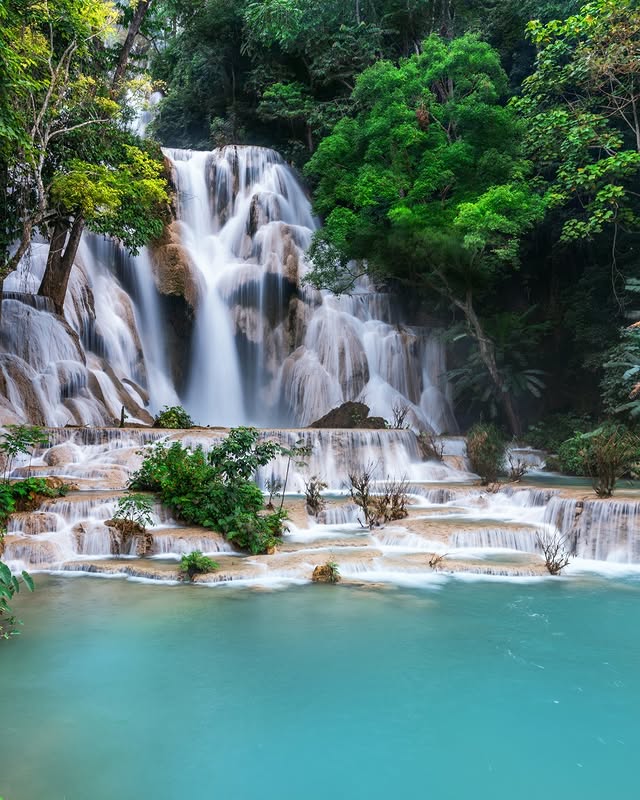
Once you reach it, you can see water plunging through a 60 m limestone wall, creating a powerful curtain of water against the backdrop of lush forests. You can find natural swimming pools in front of the waterfall, which is a refreshing place to take a plunge.
After this, if you are feeling more adventurous, you can hike up to the top of the waterfall. But remember that you won’t have the view of the waterfall, but instead you can see dense hills at a distance.
There are two ways to reach the top
- The left side of the waterfall has a long metal staircase that takes you up (542 steps approximately).
- The right side of the waterfall also takes you to the same place, but you’ll have to climb up on a muddy and steep trail.
Along with the views, the top has a deck cafe that is known as ‘The View Cafe’. Next to the cafe, you also have a natural pool with not so many people choosing to climb up. (Visiting the cafe will be an extra charge of approximately 30,000 kip).
Bonus: The park has a bear conservation sanctuary known as the ‘Tat Kuang Si Bear Rescue Centre’. It’s where you can see bears being playful, and visitors say that it makes them happy. Making it part of the Laos main attraction list.
Note: Men being shirtless, women wearing bikinis, and public displays of affection are not allowed at the falls.
Tip: Make sure to get there as soon as the park opens. Otherwise, you’ll see a busload of people visiting a bit late, as it’s a popular tourist attraction.
- Price: 60,000 Kip (245 INR) / person (Approx.)
- Timings: 8:00 am – 5:30 pm
Pak Ou Caves (29 KM Away From Luang Prabang)
Imagine yourself on a boat gliding slowly in a river, and a massive vertical limestone hill slowly starts revealing itself. That is exactly what you will experience when you travel from Luang Prabang to the Pak Ou Caves for 30 km by boat.
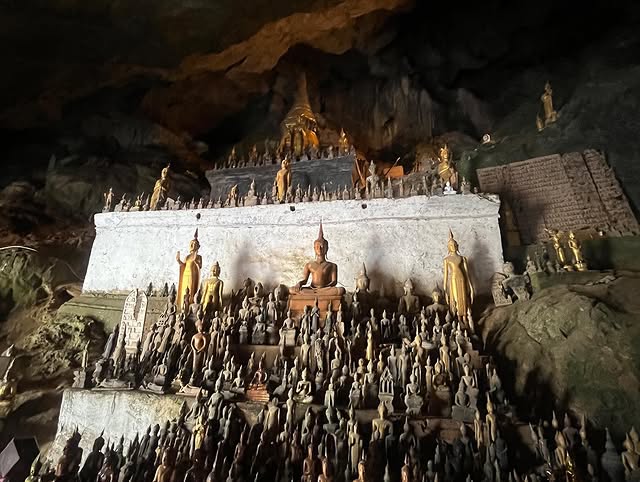
Pak Ou Caves is made up of two main chambers: the lower cave, Tham Ting, which sits right above the Mekong. And the upper cave, Tham Theung, is situated higher into the limestone cliff.
The place is famous for its huge collection of Buddha statues (4000 statues approx.) in all shapes and sizes. You can find tiny to big statues everywhere in the cave.
Originally, the caves were used by indigenous tribes who worshipped ‘phi’, the nature and river spirits. As Buddhism gradually spread across Laos, the site transformed into a sacred Buddhist shrine, with devotees placing thousands of Buddha statues inside the chambers.
- 2-hour boat ride from Luang Prabang to the caves costs
-
- 15,000 kip (61 INR) for a small boat
- 50,000 kip (204 INR) for a big boat
- Cave entrance fee: 30,000 kip (122 INR)
- Timings: 8:00 am – 5:30 pm
Elephant Conservation Centre (ECC) (120 KM From Luang Prabang)
Nam Pouy National Protected Area is a forest that spans 472,000 acres of land. Elephant Conservation Centre is situated near the forest to protect and preserve Asian elephants.
This centre has 5 stages of elephant care.
- Rescue – Elephants that were once used for logging work were sold to tourist attractions and circuses. Those wildlife victims trafficked are rescued and brought to this centre.
- Rehabilitate – The rescued elephants are taken to the vet to check how good of a shape they are in, and if not, the staff treat them.
- Reherd – Most of the elephants that were at bad places might not have been allowed to socialise with other elephants. But elephants are social animals, and they need to be in herds to have a better life. So, the staff try different methods to get the elephants to socialise with each other.
- Rewild – Once the elephants seem good to go, they will be microchipped and released into the wild. The Nam Pouy park’s CCTVs and the GPS trackers of the elephants will let people keep an eye on them.
Sayaboury Elephant Centre conducts a programme that lets visitors stay there and learn about the elephants and how they are treated. During this programme, you stay for one or multiple days in their in-house cottages, overlooking the river and the forests.
These programmes let you observe elephants; your guide will explain the process, go on forest walks with the gentle giants and spend time with them. Activities will depend on the type of package you pick.
- Prices:
-
- Discovery 2D/1N – 220 USD (19,524 INR)
- Exploration 3D/2N – 310 USD (27,511 INR)
- Back to the wild 8D/7N – 1990 USD (1,76,605 INR)
(All the activities, stay and food are included in the approximate price).
Pakse
It is the third-largest city in Laos, offering a level of convenience similar to Vientiane but also major natural attractions. However, the town is small and can be easily travelled within.
Pakse is also the gateway to enter the Bolaven Plateau, highlands of Laos that are covered in deep jungle, rugged terrain and waterfalls.
Things to do in Pakse: Waterfalls and Giant Buddha statue
- Tad Fane – Being the highest waterfall in Pakse, the twin waterfall drops from a height of 120 m, creating a jaw-dropping waterfall in the region. You can also zipline across the waterfall, which is discussed in this blog.
- Tad Yuang – A popular waterfall among the locals. Reach the top of the waterfall and then take 200 wooden steps down to a viewpoint. If you want, you can climb further down through a rocky trail and reach the pool of the falls. However, be cautious and don’t venture down during the monsoon.
- Wat Phou Salao is a Buddhist shrine that has a Buddha statue that overlooks the city of Pakse. You can either take a taxi/tuk-tuk or climb the stairs to reach the temple.
Tad Fane (38 KM From Pakse)
This waterfall should be a must-visit on everyone’s bucket list. This twin waterfall is 120 m long, and the water falls into a canyon. The waterfalls themselves look amazing, but do you know what’s more fun? Ziplining above them.
Yes, Green Discovery Laos has set up a zipline that is 1,542 feet in length, and it’s hovering at a height of 984 feet. It is one of the most thrilling, adventurous and fun things to do in Laos.
The view of the waterfall from such a dizzying height is magnificent.
If you visit Tad Fane in the rainy season, it could be a plus or a minus. You will be at a higher viewpoint compared to the waterfalls. Due to that, the clouds and the mist will be closer to you, creating a beautiful, dreamy effect. However, if it gets super misty, then you won’t be able to witness the waterfall.

- Price: (Approx.)
- 40 USD/person (3545 INR) – Just Zipline
- 48 USD/person (4254 INR) – Plus video footage on your phone
Vat Phou (44 KM From Pakse)
A UNESCO heritage site that is older than the famous Angkor Wat in Cambodia. Vat Phou is located in the southern part of Laos and was built back in the 10th-11th century, while Angkor Wat was built in the 12th century.
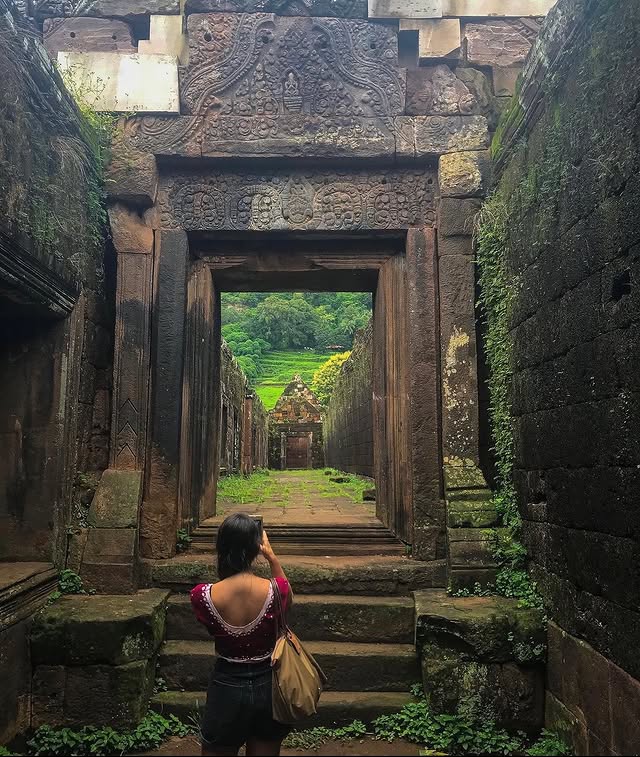
This site sits on the foothills of Mount Phou Kao; Ligaparvatha was the early name, due to the lingam-shaped rock on the summit. The place has two palaces – ‘Ho Thao’ and ‘Ho Nang’. It also has several temples and reservoirs.
Both huge palaces are built next to each other and only the walls exist now, while the middle part is empty. Passing through the palaces, you’ll find a staircase that is built with square and rectangular stone blocks.
At a point, you’ll see a small shrine that has multiple Buddha statues, all carved on rocks. From that elevation, you can witness the entire view of the palaces, two reservoirs and endless paddy fields.
- Price: (Approx.)
- 55,000 Kip (224 INR) – Entrance fee
- 20,000 Kip (81 INR) – Parking
- Timing
-
- 8 am – 6 pm (Vat Phou)
- 8 am – 4 pm (Museum)
Si Phan Don – 4000 Islands (130 KM From Pakse)
If you were a bird flying above the Mekong River over Champasak province, you’d see thousands of landmasses in the middle of the river. It’s like one big land broken and scattered into tiny islands. That’s why Si Phan Don is known as “The 4000 Islands”.
Some of them are large, with villages and farms made of them. Meanwhile, some are extremely tiny with only one tree on them. Looks too cartoonish.
Amidst all these islands, a few are big and popular.
- Don Det: An Island for Foreign Backpackers. Has backpacker hostels, cafes and even a few party places.
- Don Khone: An island of true sightseeing, packed with temples, waterfalls and a few guesthouses. Best island to cycle through. Don Det and Don Khone are connected by a bridge for easy access.
- Don Khong: The largest island of the region, but it is visited by fewer people. An ideal place to do nothing but eat fresh fish, crab, and sticky rice and relax.
- Don Som: Similar to Don Khong but much smaller. Best for a few-hour getaway.
These islands are best for island hopping and resting. Imagine spending the entire day sleeping on hammocks under trees, cycling around, eating at tiny cafes, and staying at cosy homestays.
The closest town to these islands is Pakse. You can take a bus from Pakse to Nakasong. And then, take a 20-minute boat ride to Don Det.
Note: Avoid tours that claim to take on dolphin sightings. Laos’ dolphins went extinct a long time ago.
Vang Vieng
A small town near the capital city of Vientiane, a backpacker’s favourite. Located right next to the Nam Song River, it is home to multiple natural bodies, turned into tourist attractions.
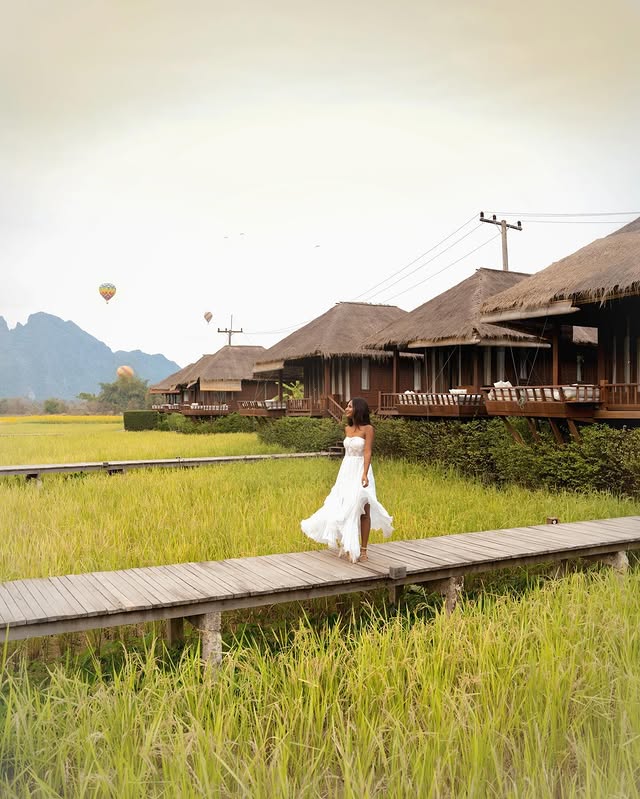
Things to do in Vang Vieng: tubing, lagoons, caves and viewpoints
Tubing
Have you ever heard of ‘lazy river’ rides in amusement parks? You can do the same thing here, but it won’t be a small stream filled with chlorinated water; instead, it will be a larger natural river with shallow and slow-flowing water.
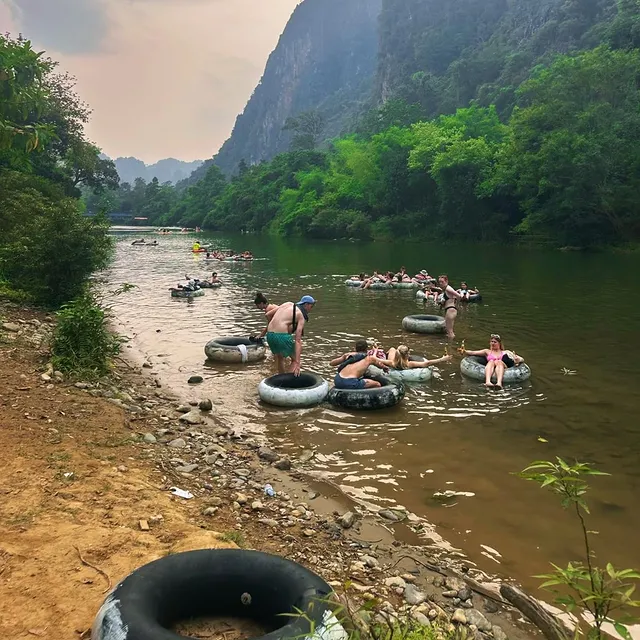
You can just rent a tube and let the slow stream take you down the river. This can be done for 3-5 hours at a time. On the way, you can also spot restaurants and cafes, which can be quick pit stops to grab some drinks.
If you’re looking for something more adventurous, you can opt for kayaking. The kayak point starts from a village called Khmu, which is 10 km north of Vang Vieng.
Lagoons
Since the river is shallow in a lot of places, lagoons are naturally formed. So that gives us 4-5 lagoons in Vang Vieng to enjoy the water safely.
Caves
Different-sized caves are all over Laos. And just in Vang Vieng, you can spot about 7-8 caves! Each is located at a different location. Tham Jang and Tham Poukham are great to check out!
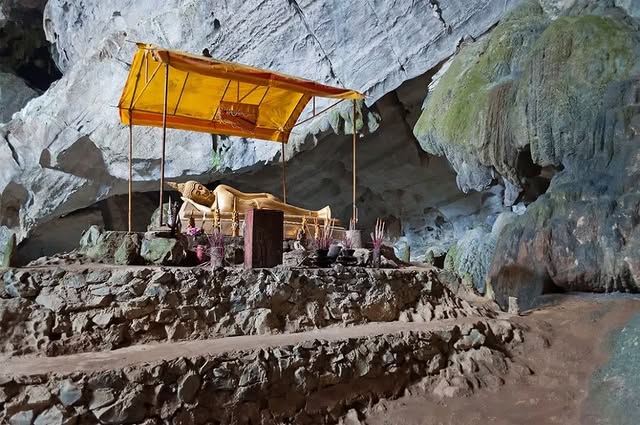
Viewpoints
Hiking cannot be missed while in Laos, as the whole country is a hilly region. The views at the top of hiking spots like Pha Ngern and Nan Xay give an amazing panorama of the surroundings. Each takes about 45 minutes – 1 hour to climb.
Xieng Khouang – Plain of Jars (210 KM From Vang Vieng)
A vast mountain ground is stocked with large stone jars, each standing at the height of a shopping cart. More than 2,000 of them are found in different areas, and nobody exactly knows why.
Sounds weird, right? Xieng Khouang, situated about 280 km from Luang Prabang, is a mystery. And the jars are extremely old; archaeologists say that their history goes back as long as 500 BC.
Some people believe that these jars were used for mass cooking by the early people or as simple rainwater conservation tanks. However, archaeologists believe that these are early funeral coffins. Due to its structure, shape, location, and remains, it could be a tomb for the early humans.
The Plain of Jars, now a remnant, attracts people to witness it. The nearest town is Phonsavan, and from there, you can either bike on your own or get a guided tour from that village.
As you enter the parking lot, you’ll pay for the ticket and have to walk for half a km to the site. The walk itself is an experience where you’ll have to cross lush paddy fields, cows, buffaloes and friendly Laotian villagers.
Site 1 is the biggest and the most visited, but sites 2 and 3 are also worth taking a look at. Site 3 is the smallest, but it’s one of people’s favourites due to its cleanliness and scenery.
This site was also used as a strategic location during the Vietnam War back in the 1960s and 70s. It was a heavily bombed area.
Note: There won’t be many restaurants around, so get some snacks and water from Phonsavan and also carry mosquito repellent.
- Price: 10,000 kip/site (40.91 INR) (Approx)
- Timings: 8:30 am – 5:00 pm
Vientiane
It is the capital of Laos, a normal city where people live to work, and it is not touristy. However, it has its own vibe with cafes and bars.
It is an ideal place to enter through the airport, spend a day relaxing and then take a train to Vang Vieng or any other part of the country. Don’t expect anything too flashy, but there are a few attractions that you can walk to while in Vientiane.
The things to do in Vientiane: temples, museums, and markets
Temples
Numerous beautiful Buddhist temples exist throughout Vientiane, including Wat Sisaket, Wat Inpeng and Wat Ong Teu. All are located within walking distance of each other.
Museum
Ho Phra Keo Museum was once a Buddhist shrine that housed the Emerald Buddha, which has since been converted into a museum after the Buddha was shifted to a temple in Bangkok.
Night Market
Most of the southeast cities will have a market that offers delicious and inexpensive Laotian specialities, snacks and drinks. This is a night market located near the riverside of the Mekong. Perfect to take a stroll after dinner.
Nong Khiaw
This Nong Khiaw town just reminds me of Himachal towns. Imagine you are walking up to the view of green hills surrounding you and a river that snakes through the valley’s bottom. Everybody is in their workout/athleisure clothes because all you can do in the town is hike, kayak, eat and sleep.
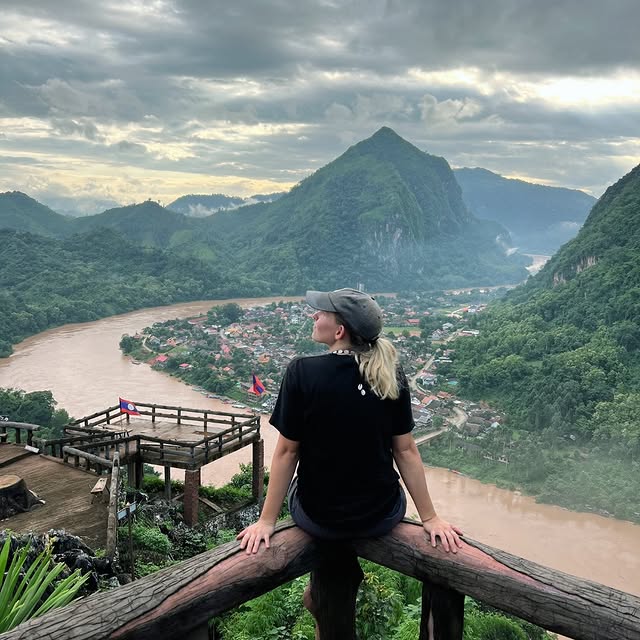
Things to do in Nong Khiaw: kayaking, cave hopping and hiking viewpoints
Kayak
There are multiple hostels and private shops where you can rent kayaks. Spend a few hours kayaking slowly in the Nam Ou River and even visit a few caves that are close to the riverbank.
Note: One of the places to rent a kayak is EcoFarm hostel in Nong Khiaw. You can get a kayak for around 100,000 kip (408 INR). Also, avoid kayaking during the rainy season when the currents are high.
Caves
Nong Khiaw has multiple natural caves that you can visit. ‘Pha Tok’ is the most popular one, which was used as a shelter during the Indochina War. It has a few leftover items from the soldiers and a small temple.
Other caves, such as Pha Noi and Pha Kuang, are worth exploring while at Nong Khiaw.
Viewpoints
As I described earlier, it’s a mountain town, and it is packed with numerous viewpoints all around that can be accessed only via hiking. Each hike will take around 45 mins – 1:30 mins, depending on your physical strength, the weather and other situational factors.
- The Som Nang: This is the most popular viewpoint out of all of them. With properly laid steps, signage and a deck at the top of the hill. It takes about 20-25 minutes to hike up.
- Pha Deang Peak: This is a challenging hike that takes approximately 1-2 hours uphill. However, the view from the top is magnificent. You can witness the entire valley from up there!
The view is so amazing that people hike up there in the late evening to camp at the top. They wake up early in the morning, watch the sunrise and then hike down. It is a famous activity in the village.
Tip: If you don’t want to do the overnight hike, then you can start the hike in the afternoon, watch the beautiful sunset and return. Make sure to carry flashlights and bug repellent with you.
- Sleeping Lady: It’s comparatively an easier hike than Pha Deang Peak, but definitely tougher than Som Nang. The trail up there is steep and rocky. There are two viewpoints. The lower one has a small deck, and that’s where a lot of people go.
The second one is at the top of the hill and again offers an amazing view of the town. It takes around 45 minutes each way.
- Price: (Approx.)
- 40,000 Kip (163 INR) – The Som Nang & Pha Deang Peak
- 15,000 Kip (61 INR) – Sleeping lady
Waterfalls
‘100 Waterfalls’ is a well-known waterfall situated about a 45-minute boat ride from Nong Khiaw. You can go on an excursion through an adventure agency, but we would recommend you go on your own with the help of village guides.
Hire a 45-minute boat ride from Nong Khiaw, which might cost anywhere from 40,000 kip (163 INR) to 60,000 kip (245 INR). And then when you arrive, you can get a guide for 100,000 kip (409 INR) and also an entry fee of 20,000 kip (81 INR).
Your journey will be an hour hike, where you will cross several waterfalls. Adding up all the small waterfalls, it will add up to around 100.
At the top, you finally visit the main waterfall, which is big, and you might get a place to swim in during the monsoon. However, the whole point of this excursion is hiking through the waterfalls and streams.
Note: Be careful of leeches in that area, mainly during the monsoon season. Carry hand sanitiser, salt or a lighter; all three will make the leech fall off. And wear water shoes.
Conclusion
Finally, you’ve reached the conclusion. We started in Luang Prabang, then travelled to Pakse and Vang Vieng and then concluded with Vientiane and Nong Khiaw.
Now you have a list of places to visit in Laos, but what’s your itinerary? To ensure a hassle-free travel experience, contact Dimaak Tours. And let us take care of your travel plan, itinerary, visa and more while you focus on the trip.
FAQs About Things to Do in Laos
Is Laos expensive for Indians?
No, not at all. Laos is one of the most affordable Southeast Asian countries for Indians to travel to. 1 LAK (Lao Kip) ≈ ₹0.0041 (Indian Rupee) and equivalently, 1 INR ≈ 245 LAK. The flight between Laos to India is expensive, not the country itself.
What’s famous in Laos?
The entire country of Laos is mountainous and is covered with lush greenery, which is itself famous. However, other Laos tourist attractions such as Kuang Si Falls, Tad Fane Falls and Luang Prabang are well-known as well.
Is Laos visa-free for Indians?
No, unfortunately, Laos is not visa-free for Indians. We need to obtain either an on-arrival visa or before travel.
