


Key Takeaways:
|
Everyone plans a vacation that usually includes markets, famous landmarks, and nightlife spots in Vietnam. With this blog, make your vacation anything but ordinary.
Vietnam has many places and diverse landscapes, one of which is Ha Long Bay caves, which you must include in your itinerary.
The limestone karst formations in Halong Bay are between 300 and 500 million years old. Over time, rainwater slowly dissolved the rock from within, creating the cave systems you see today.
Moreover, some of the Halong Bay caves in Vietnam were used as wartime field hospitals and military command posts during the Vietnam-US War.
The Best 9 Halong Bay Caves in Vietnam
In this guide, you will know about some of the best sites to choose from on a Halong Bay trip.
Before jumping into the details on the caves, understand the entry cost of these 9 Halong Bay Caves in Vietnam.
Most are included in cruise-route tickets, not charged individually.
Sung Sot, Thien Cung, Dau Go, Luon, Me Cung, and Trinh Nu are all covered by a single route and cost approximately 2,100 INR as the Central Bay fee.
Then, the separate entry fee for Dark & Bright Cave is approximately 1,058 INR, which is included in the Lan Ha Bay cruise.
Thien Canh Son is priced based on its specific cruise route, but separately it costs approximately 1,023 INR.
Trung Trang costs approximately 320 INR, which comes under the Cat Ba National Park ticket.
Now, let’s look at each cave and what the experience is like when you visit.
1. Sung Sot Cave (Surprise Cave)
Sung Sot is the largest cave in Halong Bay, with more than 10,000 square metres. French explorers found it in 1901 and named it Grotte des Surprises. Then in 1994, Halong Bay was listed as a UNESCO World Heritage Site.
The cave has two main chambers. The first one is full of natural light and used as the entry section, with stalactites and stalagmites enhanced by artificial lighting.
Then a narrow passage leads into the second chamber, which is larger, with ceilings rising over 30 metres in some places.
The rock formations are associated with the legend of Thanh Giong, a Vietnamese hero. You will see shapes resembling a horse and a sword.
Sung Sot is included in most cruise itineraries, which is why it gets crowded, especially during peak season (October to April).
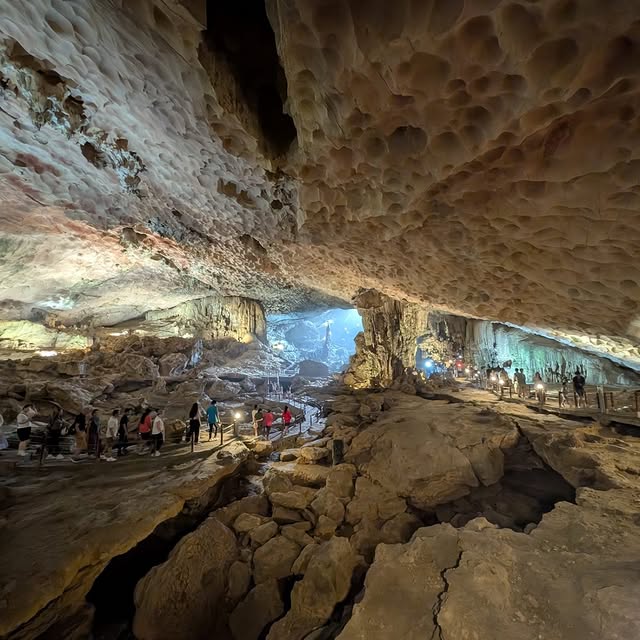
2. Thien Cung Cave (Heavenly Palace Cave)
Thien Cung Cave was rediscovered in 1993 after years of being hidden by the jungle. The entrance was found by a local fisherman while taking shelter.
The place is nearly 10,000 square metres and is divided into three chambers.
According to the legend, the Dragon King held a seven-day wedding ceremony inside the cave after falling in love with a mortal girl named May.
The wedding was attended by gods, fairies, and creatures from across the mythical world. You can see stalactites in the shapes of dragons and phoenixes, which are said to represent the guests. Also, the central chamber has four large pillars, often described as supporting the “roof of heaven.”
3. Dau Go Cave (Wooden Stakes Cave)
The French visited the Dau Go in the 19th century and called it Grotte des Merveilles, Cave of Wonders. It covers 5,000 square metres and has three chambers.
The name Dau Go means wooden stakes. In 1288, Vietnamese general Tran Hung Dao is said to have stored sharpened wooden stakes inside this cave before deploying them across the Bach Dang River.
The entrance arch is 12 metres high and 17 metres wide, and it allows a good amount of natural light into the first chamber.
The second chamber has clusters of stone flowers. The third chamber, the largest, contains a freshwater well. Stalactites here are described as resembling a forest of wooden stakes.
You can visit this cave along with Thien Cung, as they are just 300 metres away.
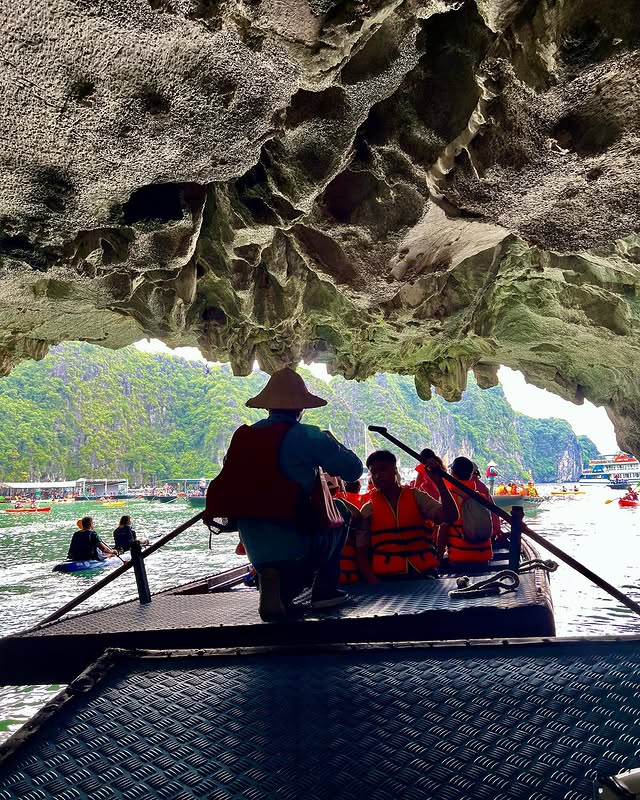
4. Luon Cave (Tunnel Cave)
Luon is a water cave and does not have walk-in access. You will be paddling in a kayak or a bamboo boat rowed by a local guide.
The entrance is a 60-metre tunnel that is beautifully carved through limestone. The ceiling is just 2.5 to 4 metres high, and it depends on the water level.
The water inside is calm, with no waves, making it suitable even for first-time kayakers. You may spot monkeys on the cliffs and birds echoing around the lagoon.
The full experience, including the tunnel passage and time on the lagoon, takes 20 to 30 minutes. If you prefer not to kayak, bamboo boats with a rower are available.
5. Me Cung Cave (Maze Cave)
Me Cung is one of the oldest human settlements (prehistoric habitation) sites in Halong Bay.
The archaeological departments found stone tools, snail shell remains, and animal fossils dating back 8,000 to 10,000 years.
It once served as a shelter and was also used for ritual purposes. The bones found here were associated with ceremonial practices of the ancient Halong people.
The entrance is narrow and leads into connected chambers with twisting passages, which gives a maze-like structure.
At the exit, a path leads to a small enclosed lagoon called the Royal Garden. Then it is followed by a viewpoint overlooking Bo Hon Island and the surrounding bay.
6. Trinh Nu Cave (Virgin Cave)
Trinh Nu Cave is known more for its legend. According to local folklore, A fisherman’s daughter, from a poor family in the bay, was forced by her parents to marry a wealthy man.
She refused to marry and waited for her real love to come, but he never arrived. Then, over time, she turned to stone in the cave.
When you visit now, you can see a rock formation inside, shaped like a woman lying down, which is said to represent her.
Across the water, there is Trong Cave (Male Cave), which faces Trinh Nu, with formations believed to represent the waiting lover.
Below the cave, there is a small beach to swim. Only a few spots offer this combination of cave visiting and beach time in Vietnam, and this is one of them, so don’t miss out on enjoying it.
7. Dark and Bright Cave (Sang Toi Cave)
Dark and Bright are actually two caves, and a lagoon connects them. The Dark Cave is a 100-metre-long tunnel with little natural light. You will be passing by a kayak or a bamboo boat.
On the other side, the cave opens into a completely enclosed lagoon surrounded by limestone cliffs, with only the sky visible. This is where the Bright Cave is located, with natural daylight.
The transition from a dark tunnel to an open lagoon is what makes this experience different from standard walk-in caves.
8. Thien Canh Son Cave
Thien Canh Son is in a different bay entirely. It is located in Bai Tu Long Bay, 25 kilometres from Tuan Chau Harbour. This is a quieter alternative to Halong Bay Caves.
The cave has three chambers with natural limestone formations. Unlike the main Halong caves, the lighting here is minimal, so the caves feel more natural.
The highest point inside the cave, from Bai Tu Long Bay, is one of the best viewpoints in the region. This cave also has beach access. At the base of the island, there is a small beach to swim or kayak.
This cave is most recommended for travellers who have already visited Sung Sot and Thien Cung and want something different, or a cave where there are fewer people.
9. Trung Trang Cave
Trung Trang Cave is around 300 metres long and is one of the largest caves in Cat Ba National Park. What makes it different is its wartime history.
The cave was once a military communication centre, between 1964 and 1968, by the Vietnamese Navy. Inside, you can still see preserved sections, such as meeting rooms, water storage, and operational spaces.
The cave also has natural stalactites and stalagmites, but the overall experience is more historical.
If you are visiting Cat Ba Island, combine this with Hospital Cave, located nearly 4 kilometres away. This was a three-level wartime hospital built inside the rock and is open to visitors.
Conclusion
Halong Bay caves are not just sightseeing stops; they are a mix of geology and history.
If it’s your first time, stick to the main routes covering Sung Sot, Thien Cung, and Dau Go. If you want fewer crowds, choose Bai Tu Long Bay or Lan Ha Bay for a quieter experience. And if you’re interested in history, caves like Me Cung and Trung Trang add more depth to your trip.
For any assistance, feel free to contact Dimaak Tours. We help you pick the cave, arrange a cruise, and even make your entire Vietnam itinerary turn into a wholesome experience.
FAQs on Halong Bay Caves in Vietnam
1. Do you need a cruise to visit the Halong Bay caves in Vietnam?
For most caves, you need to book a cruise; for some, you need a day boat. You can visit the Thien Cung and Dau Go on a day tour via boat without an overnight cruise.
2. Which is the most beautiful cave?
Thien Cung is the most consistently praised for its visuals. It is especially liked for the Dragon King wedding legend and the celestial stalactite formations. Then the Sung Sot cave is best for its scale, and Thien Canh Son for atmosphere and the view from the top.
3. How much time do you need to explore Halong Bay caves?
Most caves take 25 to 45 minutes, but if you are visiting multiple caves, book a full-day or overnight cruise.
